

digital transformation
data governance
salesforce


Marketo users might notice something curious about the header image.
Yes, that’s not Adobe’s CEO. It’s Steve Lucas, then CEO of Marketo, in San Francisco in 2017.
Stay with me for a moment.
Artificial intelligence is forcing investors to rethink the economics of enterprise software. Adobe’s announcement that CEO Shantanu Narayen will step down after nearly two decades highlights how leadership transitions often coincide with major technology shifts.
Adobe continues to report strong financial results. Its subscription platforms remain highly profitable and widely adopted across industries. Yet the company’s share price has struggled over the past year. That contrast says a lot about the current moment in enterprise software. Operational performance remains strong, but markets are beginning to ask deeper questions about how artificial intelligence may reshape the competitive landscape.
Shantanu Narayen has led Adobe through one of the most successful transformations in enterprise software. When he became CEO, Adobe was still largely a packaged software company built around products like Photoshop and Acrobat. Over the following years, the company reinvented itself as a subscription platform business.
Creative Cloud changed how creative professionals access tools.
Document Cloud transformed digital document workflows.
Experience Cloud positioned Adobe as a major enterprise platform for marketing and customer experience.
Together, these platforms turned Adobe into one of the most profitable recurring revenue companies in the software industry. But technology cycles never stand still.
Artificial intelligence is now accelerating the pace of innovation across the entire sector. New tools appear faster than before. Development cycles are shortening and the cost of building software capabilities is falling.
For investors, that creates uncertainty about how the next phase of enterprise software will evolve.
Leadership transitions often happen at precisely these types of strategic inflection points.
Much of the public discussion around Adobe and AI focuses on technology. Firefly, generative design tools and machine learning features across Adobe’s product portfolio receive plenty of attention. But investors tend to frame the issue differently. The key question is not whether Adobe can build AI.
The real question is economic.
Who will capture the value created by AI?
If artificial intelligence lowers the cost of building software features, competitors may emerge faster. Product differentiation may become harder. Pricing pressure could increase across the industry.
These concerns are not unique to Adobe. Similar questions are being asked about other major enterprise software companies such as Salesforce, HubSpot and Atlassian.
Markets are trying to understand whether AI strengthens the position of large software platforms or whether it redistributes value toward smaller, faster-moving tools.
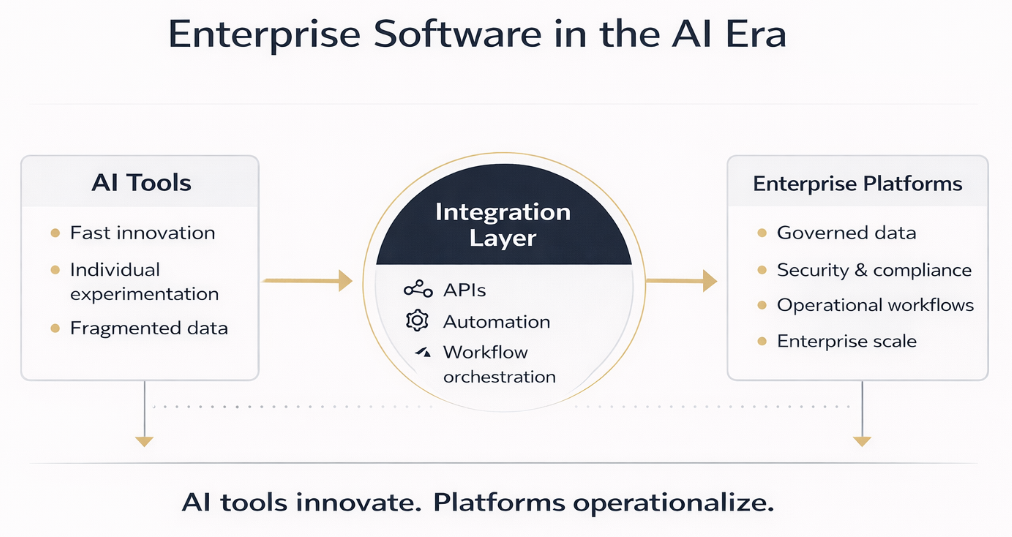
Much of the current AI excitement focuses on individual tools. But enterprise environments operate differently. AI capabilities only become operational when they connect to governed data, APIs and enterprise workflows. That is where enterprise platforms continue to play a critical role.
One aspect often overlooked in the current AI debate is how large organisations actually operate. Many of the new AI tools gaining attention today are used bottom-up. Individual employees experiment with generative tools, build small automations and explore new workflows. That experimentation can be powerful.
But enterprise environments operate under very different constraints.
Large organisations require controlled access to sensitive customer data. Systems must integrate with operational infrastructure. Security, compliance and auditability are not optional. This is where enterprise platforms continue to play a crucial role.
CRM systems, marketing technology platforms and customer data ecosystems increasingly function as the operational backbone of modern commercial organisations. They provide governed datasets, structured APIs and orchestrated workflows that allow AI capabilities to be deployed safely at scale.
In practice, artificial intelligence may actually increase the value of well-governed enterprise platforms rather than replace them.
My own introduction to the Adobe ecosystem dates back to the Marketo era, before the company was acquired by Adobe. What stood out at the time was the strength of the practitioner community around the platform.
Marketing automation was evolving quickly, but the real shift was already visible: enterprise marketing was becoming infrastructure.
AI is likely to accelerate that trend rather than reverse it.
Early days of the Marketo community: Steve Lucas (then CEO of Marketo) with Maarten Westdorp and Arjen Segers in Moscone Center San Francisco, April 2017.
The choice of Adobe’s next CEO will inevitably be interpreted as a signal about the company’s strategic priorities for the coming decade.
Leadership transitions after long tenures rarely happen in isolation. They often coincide with deeper shifts in technology cycles and investor expectations.
Three questions will likely shape the conversation.
First, what leadership profile will the board prioritise? A product innovator, a platform strategist or a leader focused on capital markets communication would each signal a different direction for the company.
Second, how will Adobe translate its AI capabilities into sustainable economic value? Investors will closely watch how AI features influence adoption, pricing and recurring revenue growth.
For enterprise customers, the answer may ultimately be less dramatic than current narratives suggest.
Large organisations will still need governed data environments, integrated systems and secure operational infrastructure. If anything, the AI era may increase the value of platforms capable of orchestrating these capabilities at scale.
Which is why the most interesting question raised by Adobe’s leadership transition may not simply be who the next CEO will be.
It may be how enterprise software platforms evolve as artificial intelligence becomes embedded across the entire technology stack.
Predictions for enterprise software in the AI era:
1. Enterprise platforms will become orchestration layers for AI
2. Data governance will become a competitive advantage
3. Ecosystems will matter more than individual features
Arjen Segers advises organisations on enterprise platforms, marketing technology and AI-driven operating models. Follow Arjen on LinkedIn.