
digital transformation
adoption


At Agentforce World Tour in Utrecht, Maarten Westdorp - VP Marketing & Communication at E.ON One, presented a standout session. The title was Revenue Transformation with Agentforce Revenue Management. The session in the Jaarbeurs was not about AI agents, it was about what had to be built before AI agents could be trusted with revenue-critical decisions.
E.ON One moved from fragmented sales data and manual pricing to a unified quote-to-cash platform in under four months. Salesforce Revenue Cloud Advanced, fully integrated with SAP invoicing, covering complex subscription and hybrid-revenue models across the energy sector. Real-time visibility into TCV, MRR, CLTV, and margin. A foundation that can support what comes next.
The room was full because enterprise leaders recognise that story. They are not chasing AI capability. They are trying to understand what needs to exist underneath it.
At one point during the session, the Agentforce Revenue Management architecture appeared on screen. It shows the full stack: Catalog, CPQ, Contracts, Orders, Assets, and Billing across the top. Agent capabilities running across all of them. Clean, modern, genuinely impressive in scope.
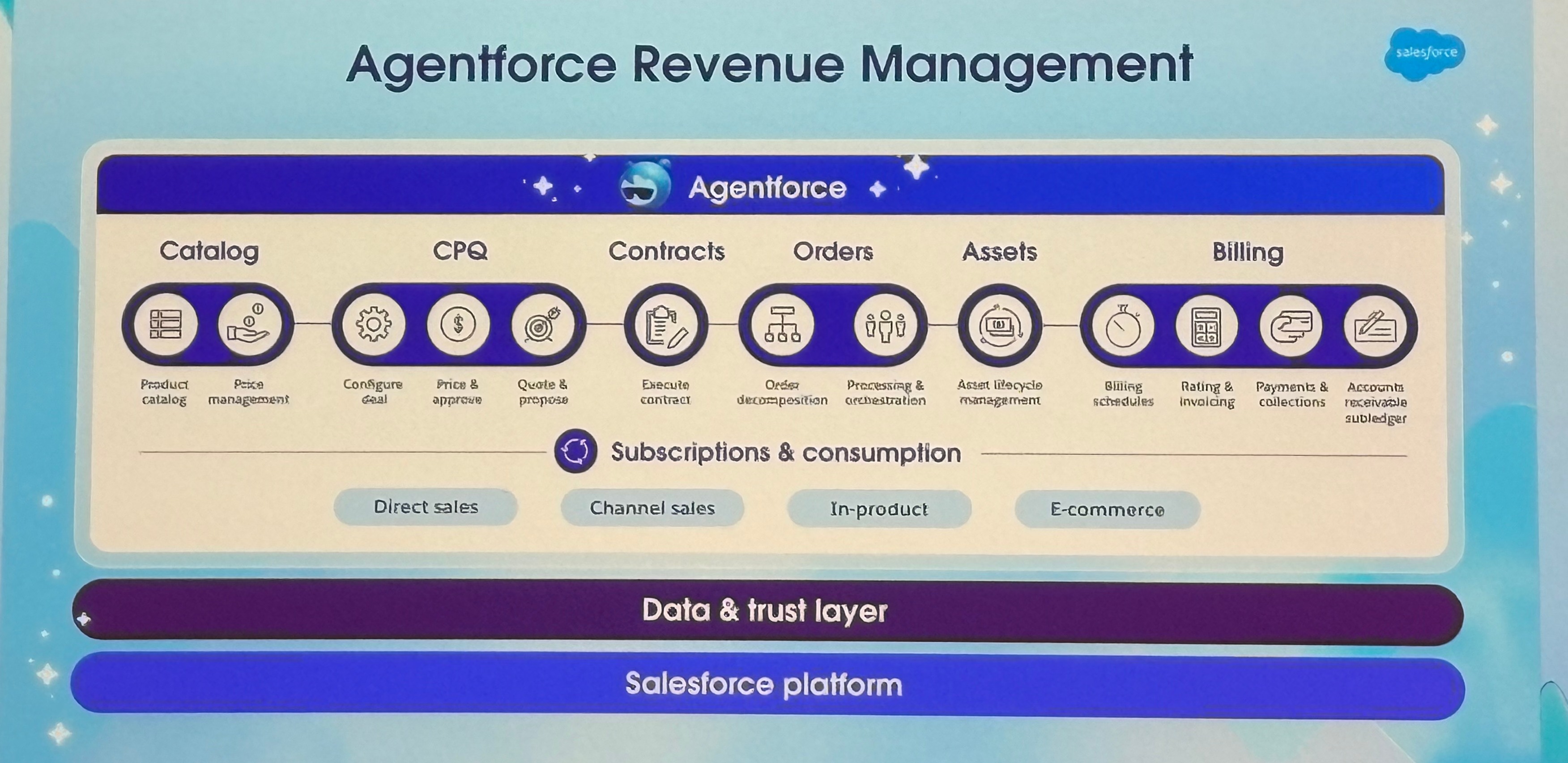
At the bottom of the diagram, sitting beneath everything else: a single layer. Salesforce labelled it "Data & trust layer." Not data infrastructure. Not integration services. Data and trust.
Trust is not a technical property, it's an earned condition
That choice of language is significant. It implies that the data is governed, that the context is reliable, that an agent acting on it is not making decisions in the dark. You cannot configure trust. You have to build toward it.
Gartner, at their Data & Analytics Summit in Orlando last month, made the same point in different language. They positioned context as "the new critical infrastructure" for enterprise AI, and found that 60% of AI projects will be abandoned through 2026 due to inadequate data preparation. The gap between AI ambition and AI production deployment is largely a foundation problem.
BCG's research on the AI value gap arrives at the same place: the 5% of enterprises generating substantial value from AI shared one distinguishing pattern - they built the data foundation before deploying agents, not alongside, not in a parallel workstream that always got deprioritised.
Salesforce, with a single label on a product diagram, said it more concisely than either of them.
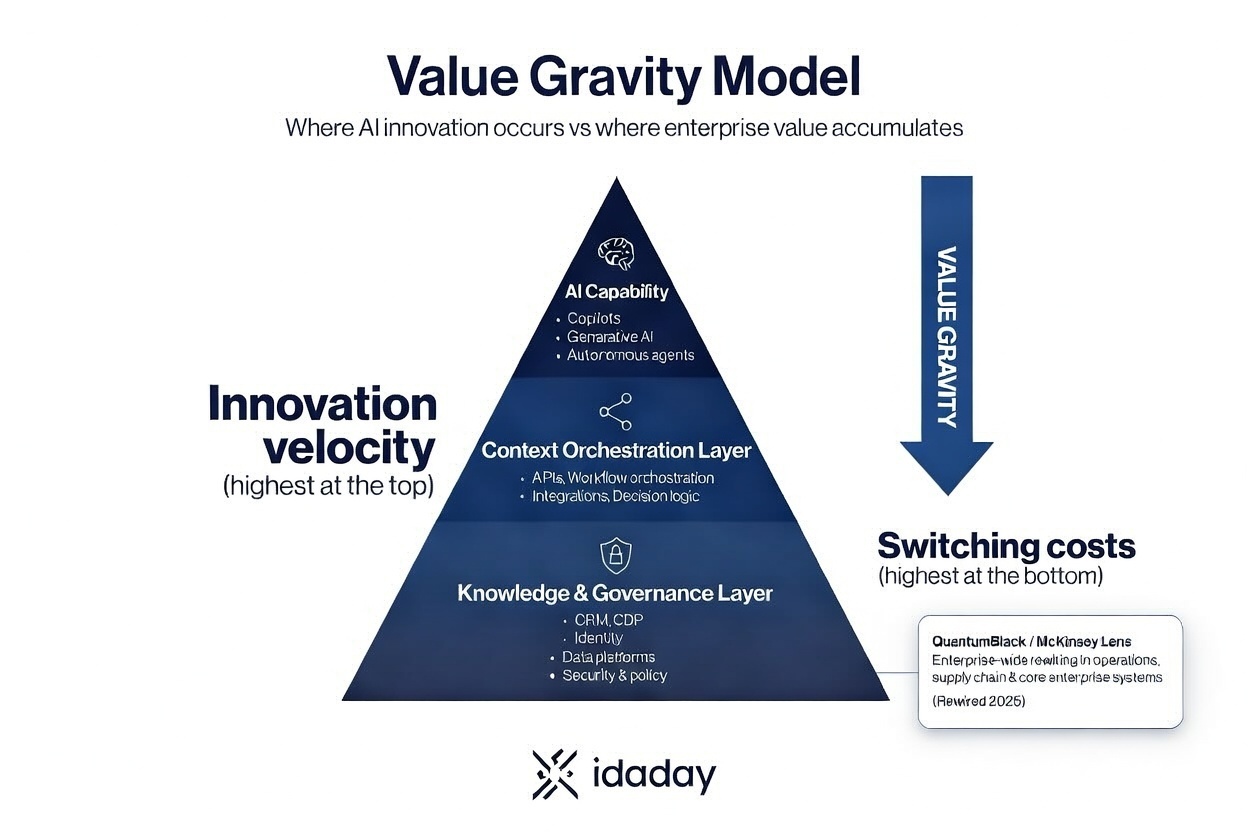
The Value Gravity Model I have been developing is built on this observation: certain layers of the enterprise stack exert a gravitational pull on economic value that others do not.
The dense base: CRM, CDP, identity, data governance, the layer Salesforce is calling "Data & trust" - is where value accretes most durably. Switching costs are massive. Context is owned. Governance is embedded. The top layer (agents, copilots, generative capability) generates excitement and moves fast, but value at that layer commoditises quickly. It flows downward toward the density.
E.ON One's story is what the right sequence looks like in practice. Build the base. Then give the agents something trustworthy to stand on.
In two weeks I will be at Adobe Summit in Las Vegas. Adobe's platform bet - Real-Time CDP, Journey Optimizer B2B, the evolving Marketo architecture - is essentially the same argument from a marketing and customer experience angle.
Different ecosystem. The same gravitational logic.